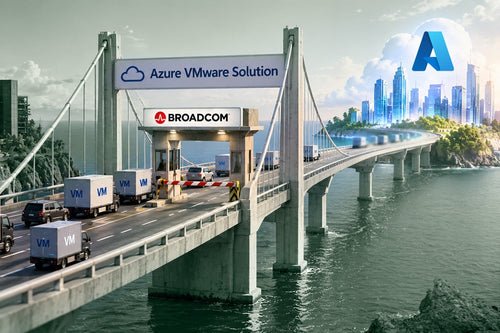


There’s a special kind of excitement that comes from opening your inbox and discovering… a cease-and-desist letter. It’s right up there with surprise audits and “quick five-minute calls” that last an hour that could have been an email. Over the last year, many organizations running VMware have found themselves on the receiving end of uncomfortable communications following the Broadcom acquisition, sometimes involving perpetual licenses that were purchased, paid for, and used in good faith.
The tone of these messages varies. The theme does not: uncertainty, rising costs, and the uneasy feeling that a platform you relied on for years now wants to renegotiate the relationship loudly.
At TrustedTech, we’ve helped many organizations navigate this moment with calm, clarity, and (when appropriate) levity. The good news? This isn’t really a licensing problem. It’s an opportunity that can reduce long-term costs, simplify governance, and modernize your IT foundation without lighting anything on fire.
Let’s talk about why moving on makes sense, and why the cloud, specifically Microsoft Azure, isn’t nearly as scary as the internet comments section would have you believe.

5 Key Points
-
VMware is no longer predictable, and unpredictability is the real cost.
Following the Broadcom acquisition, rising prices, licensing uncertainty, and aggressive enforcement have transformed a once-stable platform into a financial and legal risk rather than a quiet utility. -
Migrating off VMware is no longer the ordeal it used to be.
Modern Azure migration tools enable stable, well-architected VMware workloads to migrate with minimal disruption, often far more smoothly than expected. -
Existing on-prem investments don’t have to be discarded.
Hybrid approaches like Azure File Sync let organizations reuse current hardware for local performance while shifting control and resilience to the cloud. -
Azure delivers cost clarity, built-in security, and simpler governance.
Transparent pricing, integrated security, and centralized policy enforcement replace surprise costs, bolt-on tools, and governance complexity. -
This shift is a strategic move, not a reactive one.
Moving to Azure reduces vendor risk, aligns infrastructure with business goals, and gives leadership peace of mind, allowing teams to focus on growth instead of managing licensing issues.
Rising Costs, Reduced Certainty, and Other Unwelcome Surprises
Perpetual licenses used to mean “buy once, sleep peacefully.” Today, for many VMware customers, it feels more like “buy once, keep your attorney on retainer.” Between subscription restructuring, price increases (sometimes to the tune of 10-50x), and enforcement actions that feel aggressive even when legally complex, organizations are being forced to re-evaluate a platform they never intended to revisit.
The bottom line is executives don’t lose sleep over hypervisors. They lose sleep over unpredictability.
When a core infrastructure platform becomes a recurring negotiation, financially and legally, it stops being an asset and starts being a liability. And when costs rise without a corresponding increase in value, the business question becomes simple:
“What are we actually paying for?”

The Myth of the “Painful Migration”
There’s a long-standing belief that migrating workloads away from VMware is an ordeal involving downtime, heroics, and at least one regrettable weekend – often with a little witchcraft sprinkled in. That belief was once earned. It is no longer accurate.
Most enterprise workloads running on VMware today are:
- Stable
- Predictable
- Over-engineered (in a very responsible way)
Which makes them excellent candidates for cloud migration.
Azure was built to absorb these workloads without drama. Virtual machines move. Networks map cleanly. Identity integrates naturally, especially for organizations already invested in Microsoft. For leadership teams, the result isn’t “a cloud project.” It’s continuity, minus the licensing anxiety.
At TrustedTech, we’ve migrated environments ranging from modest to massive, and the most common feedback afterward is:
“That was… it?”
Yes. That was it.
Your Hardware Isn’t Obsolete, It Just Lacks Vision
One of the more satisfying parts of leaving VMware behind is realizing you don’t have to throw away the infrastructure you already paid for. That server stack in your data center doesn’t need to become a very expensive conversation piece. That sunk cost isn’t as sunk as it seemed.
Using technologies like Azure File Sync, organizations can repurpose existing on-prem hardware as local cache and file servers, while Azure becomes the authoritative source of truth.
Think of it as giving your hardware a semi-retirement:
- It still works
- It still provides local performance
- It no longer carries the emotional burden of being mission-critical
Users get fast access. IT gets centralized management. Finance gets to stop depreciating anxiety.
Everyone wins.

Cost Savings That Actually Stick
Yes, cloud migrations can save money. The conversion of a capital expense into an operational expense. But more importantly, they replace surprise costs with visible ones.
In Azure:
- Infrastructure costs are transparent
- Scaling is intentional
- Licensing aligns with usage
For organizations already licensed with Microsoft, the economics improve even further. Existing agreements can reduce compute costs, simplify compliance, and eliminate redundant licensing models that quietly drain budgets.
And unlike traditional virtualization platforms, Azure doesn’t charge extra for innovation. Security features, governance controls, and resilience tooling are baked in not sold as add-ons with ominous footnotes.
Security Without the Extra Meetings
Security conversations often start with, “We should probably do something,” and end with a spreadsheet and a 20-page plan that is read once and never opened again.
Azure changes that dynamic.
Built-in security capabilities provide:
- Continuous monitoring
- Identity-centric protection
- Centralized policy enforcement
For executive teams, this means fewer bespoke solutions, fewer exceptions, and fewer emergency briefings that begin with “We just detected something unusual.”
Security becomes systemic, not situational.
Governance That Doesn’t Require a Decoder Ring
One of the most underappreciated benefits of moving away from legacy virtualization is the simplicity of governance.
Azure offers:
- Centralized visibility
- Consistent policy enforcement
- Clear ownership and accountability
If your organization already lives in the Microsoft ecosystem, identity, productivity, and collaboration, the integration feels less like “another platform” and more like completing a sentence.
It’s infrastructure that behaves the way leadership expects infrastructure to behave: predictably, quietly, and without requiring a standing committee.

We’ve Done This Before. Repeatedly. Successfully.
TrustedTech has helped organizations make this transition repeatedly. Not as a reactionary move, but as a strategic one.
The benefits extend far beyond cost:
- Improved security posture
- Simplified operations
- Better alignment between IT and business goals
- Reduced vendor risk
- And perhaps most importantly: peace of mind.
When your infrastructure stops being a legal liability, your leadership team can focus on growth instead of governance archaeology.
The Bottom Line (No Legal Review Required)
Leaving VMware isn’t about abandoning virtualization and everything you’ve built. It’s about choosing clarity over complexity, predictability over posturing, and modernization over maintenance.
If your current platform is making headlines for the wrong reasons and your finance team is noticing, it may be time to explore a calmer, more sustainable path forward.
Azure offers that path. TrustedTech knows how to guide you through it. And no, it doesn’t require a weekend outage, a forklift upgrade, or a therapy session afterward.
At the very least, it replaces legal ambiguity with operational clarity, and clarity is far less expensive to maintain.
Interested in seeing what this looks like for your organization? Let’s talk before your inbox does.
Find out more about a migration to Azure