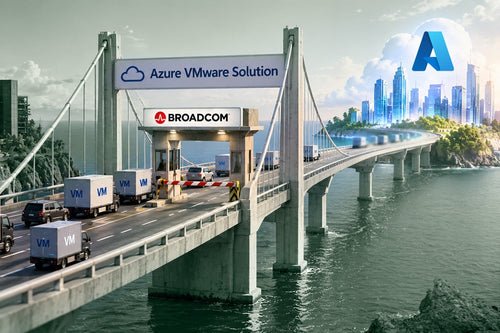


For today’s CIOs and CFOs, a multi-cloud strategy is a top priority. Relying on a single cloud provider exposes operations and budgets to risks such as downtime, vendor lock-in, and escalating costs. It’s no surprise that most enterprises now use multiple clouds to boost resilience and flexibility without inflating costs.
Defining Multi-Cloud vs. Hybrid
Multi-cloud means using multiple cloud providers (e.g. Azure, AWS, GCP) together, whereas hybrid cloud mixes public cloud with on-premises infrastructure. Multi-cloud strategies enable IT teams to use the best cloud for each workload and avoid dependence on any single vendor, a practice especially useful for organizations with large-scale or strict compliance needs.

Strategic Roles of Azure, AWS, and GCP
Each cloud platform has unique strengths. Microsoft Azure excels at enterprise integration, identity management, and compliance, ideal for Microsoft-centric and regulated workloads. Amazon Web Services (AWS) offers the broadest service catalog and global infrastructure for large-scale deployments and fast innovation, while Google Cloud Platform (GCP) leads in analytics and machine learning for data-intensive projects.
In a multi-cloud strategy, each workload runs on the provider that best serves it. The table below highlights the core role of each platform:
| Cloud Platform | Core Strengths & Best Uses |
|---|---|
| Microsoft Azure | Deep Microsoft integration; strong security & compliance (ideal for enterprise and regulated workloads). |
| AWS | Largest service portfolio; global scale (best for diverse workloads and rapid scaling). |
| Google Cloud | Advanced analytics & AI/ML (best for data-driven projects). |
Reducing Risk with Multi-Cloud
Using multiple clouds can significantly reduce operational risks:
- Avoid Vendor Lock-In: Spreading workloads across providers reduces reliance on a single vendor. This hedges against any single cloud’s outages or policy changes.
- Improve Business Continuity: If one cloud goes down, critical systems can fail over to another. This redundancy means an incident at one provider won’t cripple operations.
- High Availability & Disaster Recovery: Multi-cloud acts as a built-in disaster recovery plan. By replicating data and services across platforms, even a regional failure in one cloud can be mitigated by another, minimizing downtime.

Security & Compliance Advantages
A well-planned multi-cloud approach can strengthen security and compliance:
- Meet Regulatory Requirements: Choose cloud services in regions and with certifications that align with your compliance needs (e.g. GDPR or HIPAA).
- Best-of-Breed Security: Each provider offers robust security features (encryption, identity management, threat detection, etc.). By combining platforms, you leverage the top security tools of each.
- Multi-Cloud Security: This approach also avoids a single point of failure: if one platform has a vulnerability, it won’t compromise your entire infrastructure.
Managing Costs Without Overspend
Done right, multi-cloud can even reduce cloud spending:
- Optimize Workload Placement: Run each workload where it’s most cost-effective. One provider may offer cheaper storage, another lower-cost compute, and so on. Matching each workload to its ideal environment prevents overpaying.
- Leverage Competition: Using multiple providers keeps pricing competitive. You can capitalize on each cloud’s discounts or special pricing offers to get the best deals.
- Enforce FinOps Discipline: Apply strong financial governance across all clouds. Use tagging, budget limits, and regular cost reviews to identify and eliminate waste. Good FinOps practices ensure flexibility doesn’t lead to surprise bills.

Implementation Roadmap
Executing a multi-cloud strategy should follow a clear plan:
- Assess & Map Workloads: Evaluate all applications (performance, compliance, cost requirements) and assign each to the cloud platform that best fits it.
- Establish Governance: Set unified security policies, compliance standards, and cost controls across all cloud environments from the start.
- Integrate & Ensure Resilience: Connect cloud networks and unify identity management. Implement cross-cloud backups and failover so one cloud can cover for another during disruptions.
- Optimize Continuously: Monitor cloud usage and spending in real time. Adjust resources and deployments over time to improve efficiency and leverage new cost-saving opportunities.
Overcoming Complexity
Managing multiple clouds adds complexity, but it’s manageable. Automation and orchestration tools help simplify operations, staff training or expert partners can address skill gaps, and centralized monitoring keeps security and performance under control. With careful planning and governance, even complex multi-cloud setups can run smoothly.

VMware-to-Azure Migration: First Step to Multi-Cloud
A popular first step toward multi-cloud is moving on-premises VMware workloads into Azure, serving as an effective on-ramp for a broader multi-cloud migration. This immediately reduces the risk and cost of maintaining physical data centers. Azure’s VMware Solution (AVS) lets you lift and shift VMware VMs to Azure without refactoring, using the same VMware tools and skillsets in the cloud.
The advantages of this move can be summarized as follows:
| Benefit of Moving VMware to Azure | Impact |
|---|---|
| Lower Costs | No on-prem hardware or maintenance. Pay for only the resources you use in Azure, often lowering total cost. |
| Minimal Refactoring | Migrate VMs without rewriting apps. Azure VMware Solution makes the move fast and low-risk using your existing VMware expertise. |
| On-Demand Scalability | Virtually unlimited capacity and global reach. Scale VMware workloads as needed and improve resiliency via Azure’s multi-region infrastructure. |
| Enhanced Security | Immediately use Azure’s built-in security & compliance (encryption, threat detection, Azure AD, etc.), often a security upgrade from on-prem systems. |
With support from TrustedTech’s Azure Cloud Services, VMware-to-Azure migrations can be smooth and strategic, laying a foundation for broader multi-cloud initiatives.

Conclusion
A well-executed multi-cloud strategy delivers greater reliability, security, and flexibility without higher costs. By running each workload on the most suitable platform (Azure, AWS, GCP), you avoid single-point failures and keep vendors competitive on pricing. The key is careful planning and strong governance to manage the complexity.
Starting with a targeted step, such as a VMware-to-Azure migration, organizations can gradually build a multi-cloud environment that becomes a driver of innovation and resilience, helping the business thrive without breaking the budget.