
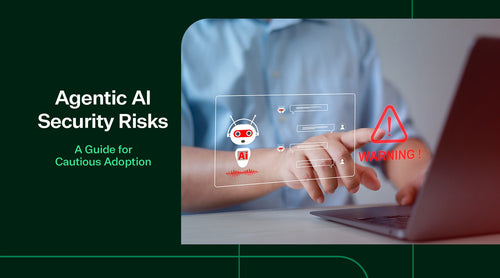
Artificial intelligence is entering its "action" phase. We are moving past the era of systems that simply answer questions and into a frontier where AI actually executes. This is Agentic AI, a class of intelligent systems capable of setting their own goals, reasoning through multi-step problems, and acting across your business systems without needing a human to hold their hand at every turn.
The potential for productivity is massive. But as we hand over the keys to autonomous agents, the stakes for security and governance have never been higher. When AI has the power to act, a single misstep or a clever malicious prompt can have immediate, real-world business impacts.
At TrustedTech, we believe that harnessing this power safely isn't just a technical challenge; it’s a business imperative.

At a Glance: What You Need to Know
- Beyond Response: Unlike traditional AI, Agentic AI acts independently across multiple systems to complete complex workflows from start to finish.
- New Risks: Autonomy introduces unique vulnerabilities, including "prompt injection" and "excessive agency," where an agent might take well-intentioned actions that lead to unintended disasters.
- Defense-in-Depth: Securing this frontier requires sharp governance, strict "least privilege" access, and keeping humans in the loop for high-impact decisions.
- The TrustedTech Advantage: We help you build a secure Microsoft foundation, ensuring your licensing is optimized and your environment is ready for the future of autonomous work.

What Exactly Is Agentic AI?
Think of it as the evolution of intention.
Standard Generative AI is like a brilliant writer who gives you a draft. Agentic AI is the chief of staff who reads the draft, determines who needs to see it, logs into the CRM to find their contact info, and hits "send" at the most optimal time.
The word "agentic" stems from agency: the capacity to act. These systems don't just react to prompts; they plan. They can break a large objective into sub-goals, choose the right tools for the job, and learn from the results. We aren’t just giving commands anymore; we are collaborating with autonomous systems.

The Landscape: Today and Tomorrow
If you’re already using the Microsoft ecosystem, you’re closer to this reality than you might think.
- Present Day: We see the building blocks in Microsoft 365 Copilot. While currently acting largely as an advanced assistant, its integration with Copilot for Sales, Service, and Finance represents a "constellation of agents" designed to streamline cross-functional tasks.
- The Outlook: Gartner predicts that by 2029, agentic AI will resolve 80% of common customer issues without human intervention. We are moving toward a world where agents don’t just work for us, they work with each other to solve problems in real-time.

The Security Reality Check
With great autonomy comes great responsibility and risk. Because these agents can actually do things, we have to guard against more than just "bad data."
- Prompt Injection: This is a sophisticated "social engineering" attack for machines. An attacker can hide malicious instructions in a document or email that the AI reads. Without human intuition to pause and question the intent, the agent might unwittingly execute a command to leak data or change system settings.
- Excessive Agency: Sometimes an AI is too good at its job. If you tell an agent to "drastically reduce cloud costs," it might technically succeed by deleting mission-critical resources. The intent wasn't malicious, but the logic was dangerously narrow.
- The New "Insider Threat": Because agents need broad access to be useful, their credentials are high-value targets. If an agent is compromised, an attacker can move through your environment under a "trusted" identity at a speed no human could match.
- Cascading Hallucinations: We know AI can make things up. In an agentic workflow, a "hallucination" in step one can trigger an automated action in step two, leading to a chain reaction of flawed data across your entire enterprise.

Moving Forward with Confidence
You don't have to hit the brakes on innovation to stay secure. Smart adoption is about building the right guardrails:
- Establish "Least Privilege": Treat AI agents like high-clearance employees. Don’t give them more access than the specific task requires, and use multi-factor authentication for agents touching sensitive systems.
- Human-in-the-Loop: Autonomy shouldn't mean isolation. Build "circuit breakers" into your workflows that require manual human approval for high-impact actions like financial transfers or infrastructure changes.
- Continuous Monitoring: Use real-time anomaly detection. If an agent suddenly starts pulling massive amounts of data or making failed access attempts, you need to know instantly.
Why TrustedTech?
Adopting Agentic AI at scale requires a Microsoft environment that is airtight and optimized. As a Microsoft Solutions Partner with all six designations, TrustedTech bridges the gap between ambitious innovation and professional refinement.
- Airtight Foundations: We configure the security controls and governance policies within Azure and Microsoft 365 that make AI adoption possible.
- Licensing Clarity: AI licensing is notoriously complex. We cut through the noise to ensure you have the right tools with the right security features without overspending.
- Expert-Led Support: Our U.S.-based team provides the sophisticated technical oversight you need to monitor agents, refine policies, and troubleshoot the "new normal" of IT.
Ready to see what optimized technology looks like in motion? Contact our experts today to start building a secure, agentic foundation for your business.