
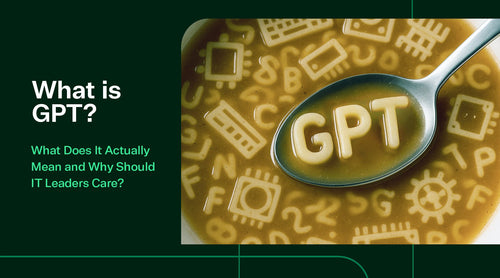
Generative AI is transforming the way organizations operate. The acronym GPT shows up everywhere, from ChatGPT to Microsoft Copilot, but what does it actually mean, and why should IT leaders care?
Breaking Down the Acronym: GPT stands for Generative Pre-trained Transformer, and each part of the acronym highlights a different capability.
Together, these elements explain how the technology creates, learns, and delivers outputs that feel natural and useful for business. To understand what makes GPT so powerful, it’s helpful to examine each part of the acronym and its role in enterprise AI.

Generative
The first part of GPT, “Generative,” highlights the model’s ability to create entirely new outputs. Unlike traditional systems that only retrieve stored data, GPT can generate text, images, and even code to match enterprise needs.
For enterprises, this translates into:
- Drafting emails, reports, and contracts in seconds. GPT can take simple prompts, outlines, or raw notes and transform them into professional documents. This reduces the manual effort required for everyday communications and ensures outputs are consistent with corporate tone.
- Creating knowledge base articles from raw notes. Instead of having staff write documentation from scratch, GPT can generate structured articles from meeting transcripts or troubleshooting steps. This accelerates knowledge management, enabling employees to access answers more quickly.
- Generating code snippets or automating configuration files. Developers can describe their needs in plain English and let GPT draft the initial code. While human review is still essential, this dramatically speeds up the start of technical tasks.
This shift from retrieval to creation is why GPT has become a cornerstone of enterprise productivity.

Pre-trained
The second element, “Pre-trained,” refers to the way GPT is developed before it is ever used in an enterprise setting. By training on massive, diverse datasets, the model arrives with a broad base of knowledge that organizations can then fine-tune for industry-specific applications.
Why this matters for enterprises:
- Fast adoption - Because GPT already understands general language patterns, teams don’t need to spend months training models from scratch. This enables organizations to transition quickly from pilot projects to production-ready use cases.
- Domain flexibility - Enterprises can fine-tune GPT with industry-specific data, such as legal contracts or financial disclosures, so the model aligns with their exact needs. This ensures outputs are not only accurate but also contextually relevant.
- Reduced training cost - Pre-training absorbs the heavy computational workload, meaning companies only need to invest in fine-tuning for their specific environment. This lowers barriers to entry for AI projects, making advanced AI adoption financially feasible.
The result is a model that comes equipped with broad knowledge and can be tailored to meet the specific needs of enterprises.

Transformer
Finally, “Transformer” refers to the architecture that enables GPT. This neural network design utilizes self-attention to capture context and meaning, enabling the model to generate responses that feel natural, accurate, and useful in business settings.
For IT teams, this means GPT can:
- Understand long technical documents without losing context
- Summarize sprawling threads into concise action items
- Answer questions about enterprise policies, contracts, or infrastructure with context awareness
Transformers are why today’s AI feels conversational and practical, not robotic.
GPT is more than a buzzword; it represents a fundamental shift in how enterprises can utilize AI to create, comprehend, and act upon information.